My image of East Africa will always conjure up the spring of 1994. I was studying photography at Winnipeg’s Technical Vocational High School.
In contrast, 50,000 Tutsi on the other side of the world had gathered at the Murambi Technical School in Rwanda believing they would be safe from machete wielding Hutu Power extremists.
History wasn’t on their side. They were all surrounded, slaughtered, and many buried alive and mummified.
In 1994, Canadian students studied things like photography, auto mechanics and electronics. Rwanda students were either killing or dying in large numbers.
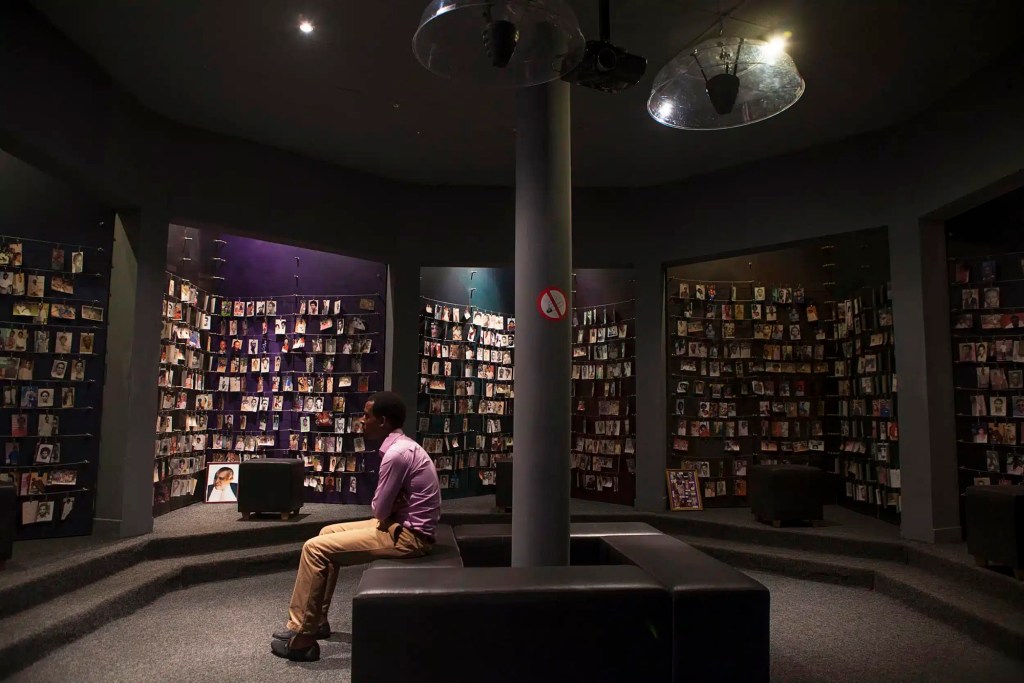
Genocide by Machete
The April 6, 1994 assassination of Rwandan President Juvénal Habyarimana – a Hutu leader who had negotiated a peace deal to share power and welcome back thousands of Tutsi refugees – triggered the start of one hundred days of mass slaughter.
Gangs of young Hutu men – known as the Interahamwe – carried out a genocidal campaign by controlling the radio waves to incite violence, purchasing large quantities of cheap Chinese machetes, and developing kill lists for Tutsi and moderate Hutu.
Rwandan Prime Minister, Agathe Uwilingiyimana was put under the protection of ten Belgian soldiers shortly after the President’s plane was shot from the sky. Those soldiers were part of the United Nations Assistance Mission In Rwanda (UNAMIR) that were monitoring the peace process.
The Interahamwe took a strategic gamble and murdered the prime minister, along with the Belgium peacekeepers. The gamble paid off. Rather than send a larger peace force, the international community withdrew their troops.
Western leaders seem willing to sacrifice troops for resources or regime change that benefit corporate interests, but not to simply preserve life by protecting people and promoting peace.
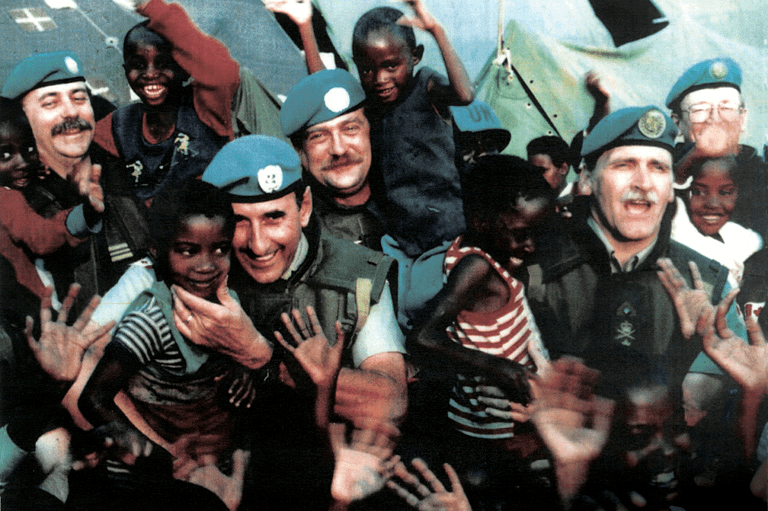
General Roméo Dallaire, right, with moustache, and other Canadian peacekeepers with children at Amahoro Stadium Kigali, Rwanda, June 1994.
Canadian Lieutenant-General Roméo Dallaire decided to defy orders and remain with other volunteers to bear witness. He did more than that. It’s estimated that his actions saved 32,000 lives by protecting safe zones (Hôtel des Mille Collines, Amahoro Stadium).
There’s no doubt that my pride in Dallaire being Canadian, and my growing interest in human rights, captured my heart and interest with the people of Rwanda.
In all, between 750,000 and 1 million Tutsi and moderate Hutu were exterminated in what is one of the most efficiently orchestrated genocides in history.
Human Rights & Solo Travel
My travel choices appear understandably weird and depressing to many who want to use their vacation to get away from the troubles of life.
Visiting sites where the largest failures of humanity took place is one way I try to maintain my own humanity.
Walking in another’s shoes forces empathy, recognition and respect. This exists beyond the deep connections we all have with each other. Self-interest and preservation should ring alarm bells that the horrors inflicted on any group of people can be inflicted on your group.
Kwibukato 32 – Remembering Genocide in Rwanda
The death of both parents the last few years has really emphasized the importance of using time wisely while my heart and legs still work.
I’m traveling to Rwanda – with a focus on the 1994 genocide. The entire month is known as, ‘Kwibukato’ – a Kinyarwanda word meaning, ‘to remember.’
I’m hopeful that this trip allows me to pay respects to the genocide of the mid-1990s.
Prologue
Rwanda itself has become one of the safest, least corrupt and reconciled nations in Africa.
However, Rwanda continues military engagement with Hutu groups in the eastern Kivu region of the Democratic Republic of Congo (DRC).
Rwanda’s role in the wars of Congo is deeply controversial. The bloody wars in the DRC next door have been the world’s bloodiest since WW2 reaching 6 million deaths.
It’s easy to forgive Rwanda for wanting to keep Hutu extremism outside Rwanda. Hutu power escaped into Congo and continued to threaten Tutsi years after the genocide.
Many argue that Rwanda continues to use this as a convenient cover to support rebel factions such as M23, who terrorize civilians as they fight the government of DRC for control of eastern Congo and its vast mineral wealth.


Leave a comment